Turbulence and Bulk Transport Laws
Turbulence and Bulk Transport Laws
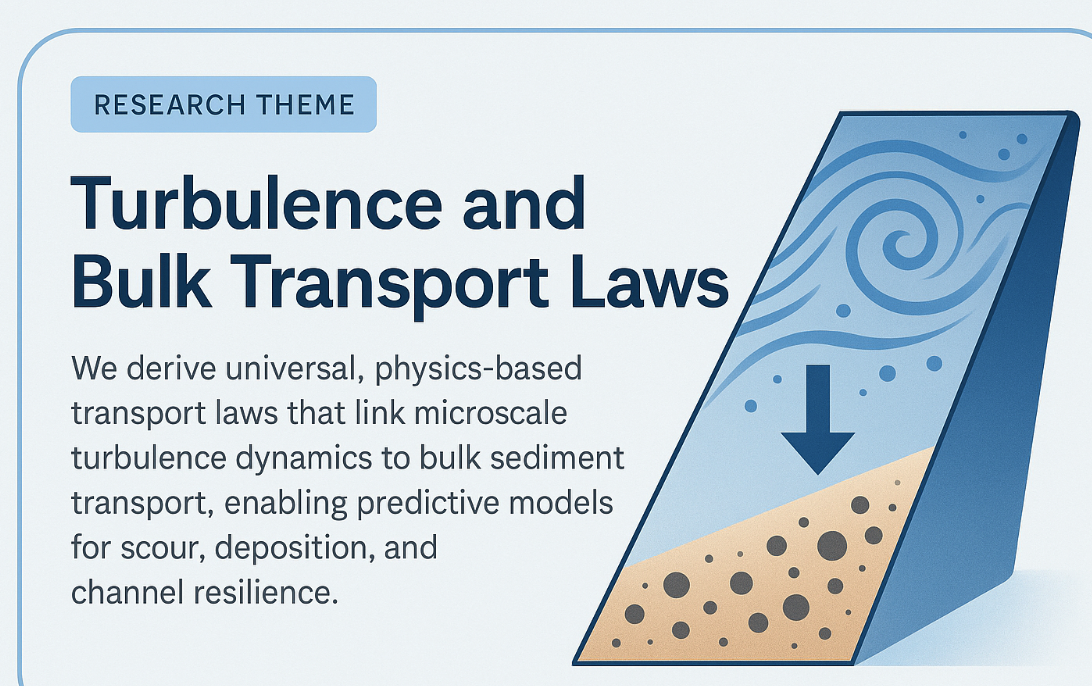
We derive universal, physics-based transport laws that link microscale turbulence dynamics to bulk sediment transport, enabling predictive models for scour, deposition, and channel resilience.
Why bulk transport laws matter
Predicting scour and deposition remains one of the most consequential challenges in river engineering, infrastructure design, and climate adaptation. Failures in bulk transport models directly translate into vulnerability of bridges, channels, and coastal systems.
Our objective is to replace empirical tuning with universal transport laws derived from turbulence dynamics.
A first-principles derivation of transport laws
Starting from the governing physics, we derive a predictive framework based on:
- Turbulent Kinetic Energy (TKE) balance equations
- Shear stress and momentum budgets
These components anchor sediment transport in measurable turbulence quantities, rather than fitted coefficients.
Link energy-containing eddies to suspended sediment concentration using co-spectral budget models.
The resulting formulation collapses five orders of magnitude of historical laboratory and field data onto a single predictive curve.
Enables physically grounded design of resilient scouring and deposition systems under changing flow regimes.
Bridging scales: from turbulence to infrastructure
This framework explicitly connects microscale turbulence dynamics—eddy energetics, shear production, and dissipation—to bulk sediment transport laws used in engineering practice.
What this framework enables
- Universal prediction of scour and deposition across flow regimes
- Reduced uncertainty in sediment transport modeling for climate adaptation
- Physically interpretable transport laws rooted in turbulence budgets
- Scalable application from laboratory channels to natural rivers
Representative Publications
- Li, S., Bragg, A. D., & Katul, G. A co-spectral budget model links turbulent eddies to suspended sediment concentration in channel flows. Water Resources Research, 58(3), e2021WR031045.
- Li, S., Bragg, A. D., & Katul, G. Reduced sediment settling in turbulent flows due to Basset history and virtual mass effects. Geophysical Research Letters, 50(22), e2023GL105810.