Generative Physical System Emulation
Generative Physical System Emulation
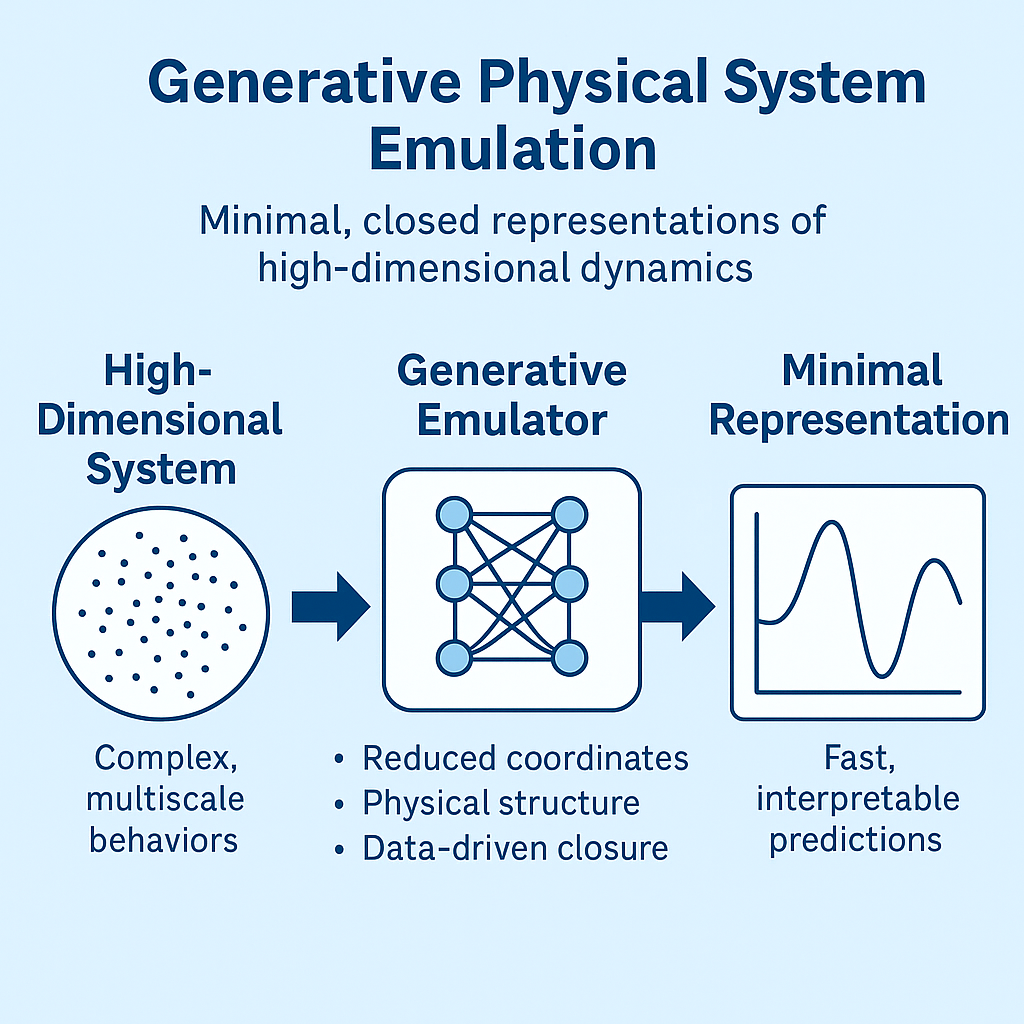
We design generative emulators of physical systems that learn minimal, closed representations of high-dimensional dynamics— enabling fast simulation, system identification, and physically interpretable inference.
Why generative physical system emulation?
Many physical systems—climate, turbulence, sediment transport, energy systems—are observed in extremely high dimensions, yet evolve on much lower-dimensional structures.
Traditional surrogates focus on reproducing outputs.
Our goal is to emulate the system itself.
In this view, uncertainty is not an afterthought: it reflects unresolved scales, regime dependence, and structural ambiguity that must be embedded in the emulator itself.
A framework for minimal and closed representations
Learn reduced coordinates that capture the system’s attractor or manifold while retaining the mechanisms that govern evolution.
Replace unresolved processes with data-driven closures that remain stable, interpretable, and physically consistent.
Neural operators and generative flows enable millisecond-scale inference for ensembles, sensitivity analysis, and scenario exploration.
What this framework enables
- Reduced-order system emulators that remain closed under evolution
- Validated physical closures with uncertainty bounds
- Regime-aware simulation, including extremes and rare transitions
- Real-time ensemble generation for stress testing and decision support
- Interpretable system identification, not black-box prediction
Science → operations
Generative emulators provide a pathway from fundamental modeling to operational use.