Machine Learning for Surrogate Model
Numerical Surrogate Models with Machine Learning
We develop turbulence-aware, physics-guided surrogate models that combine machine learning with first-principles constraints to predict geomorphic transport processes in rivers and coastal systems.
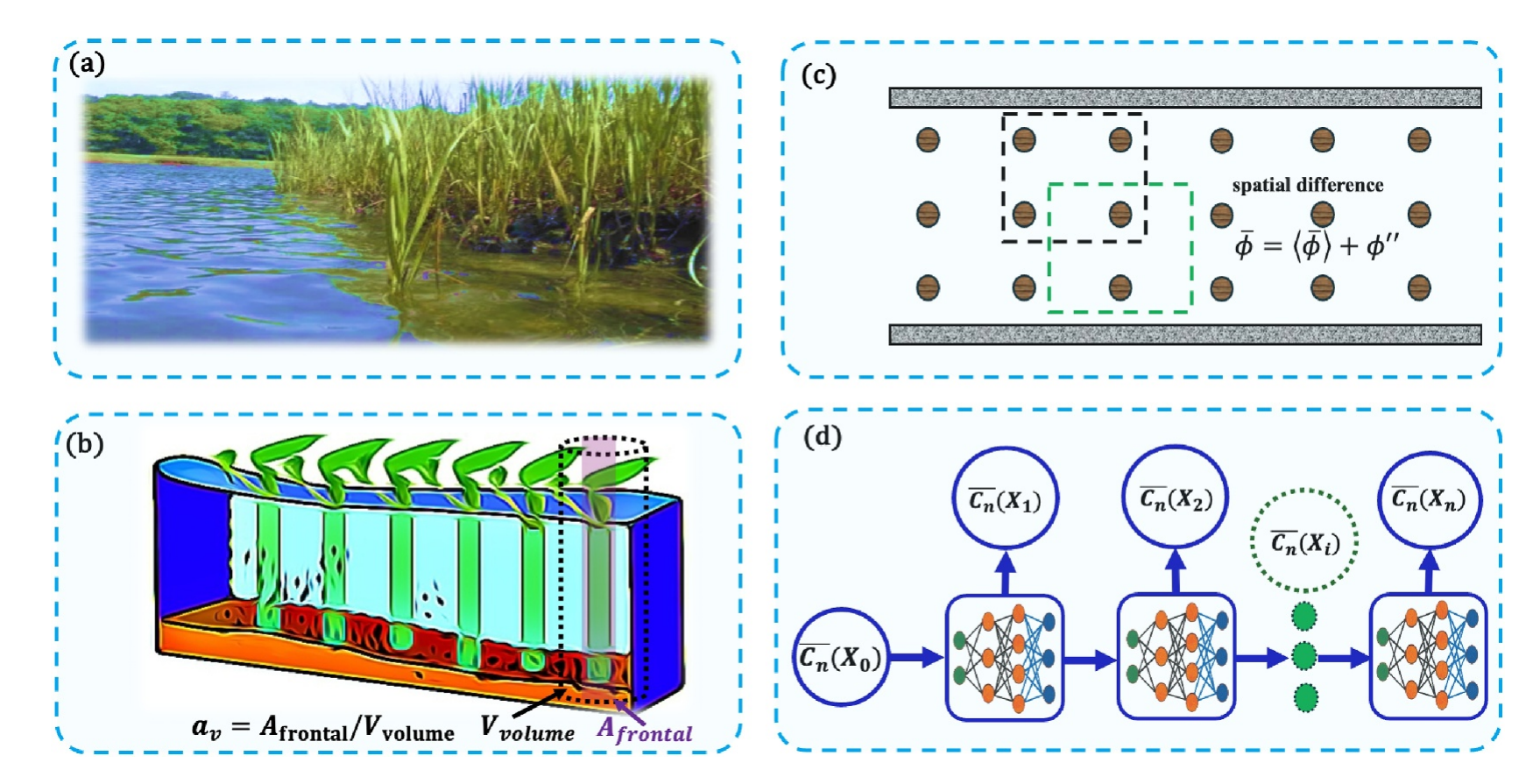
From empirical formulas to physics-guided surrogates
This project aims to build a generalizable, turbulence-aware surrogate modeling framework that combines machine learning with physical constraints to predict geomorphic transport processes in rivers and coastal systems. The overarching goal is to move beyond empirical formulas and instead develop first-principles-guided ML models that learn how microscale turbulent structures drive landscape-scale sediment response.
At its core, the framework seeks to answer a fundamental question:
To pursue this goal, we integrate:
- turbulent kinetic energy (TKE) budgets
- shear-stress scaling and covariance closures
- symbolic regression for interpretable laws
- generative surrogate modeling for fast emulation
These surrogates reveal governing dynamics that are not directly observable, offering a pathway to physically interpretable prediction instead of black-box fitting.
Framework components
Use TKE budgets, Reynolds stresses, and coherent structures to define physically meaningful inputs to ML models, ensuring that surrogates “see” the right turbulent scales.
Replace expensive numerical solvers with ML surrogates that emulate transport fluxes and concentration fields while respecting conservation and scaling constraints.
Extract closed-form transport laws from trained models, bridging data-driven surrogates with interpretable, physics-based expressions.
Case studies
1. Suspended sediment transport in vegetated channels
A physics-informed ML surrogate infers sediment dispersion fluxes from turbulence statistics, linking canopy-scale mixing to cross-sectional concentration fields in laboratory channels. This resolves a long-standing gap between:
- microscale turbulent bursts near and within the canopy, and
- bulk suspended sediment transport capacity at the reach scale.
The surrogate connects turbulence metrics directly to transport closures, providing a physically consistent alternative to ad hoc mixing-length formulas.
2. Pier scour formation in erodible beds
By coupling ML with TKE and shear-stress budget closures, the framework predicts equilibrium scour depth using dominant turbulent eddy scales — a quantity previously inaccessible to classical theory.
Here, symbolic regression is used to:
- distill learned relationships into analytical transport laws
- translate turbulent signatures into geomorphic response
- clarify which scales and statistics exert primary control on scour depth
Together, these examples demonstrate the broader ambition of this research program:
to unify fluid mechanics, geomorphology, and AI into a single modeling architecture capable of discovering new physical laws.
Representative Publications
- Li, S., Qu, Y., Zheng, T., & Gentine, P. (2024). Machine-assisted physical closure for coarse suspended sediments in vegetated turbulent channel flows. Geophysical Research Letters, 51(20), e2024GL110475. 🔗 Read the paper
- Li, S. (2025). Integrated turbulence and machine learning models explain pier scour in erodible channels. Water Resources Research, 61(9), e2024WR039088. 🔗 Read the paper