Probabilistic Data Assimilation
Probabilistic Data Assimilation for Climate Extremes
We design distribution-aware, physics-grounded data assimilation frameworks that learn how full probability distributions — not just single trajectories — evolve in a changing climate.
Why probabilistic data assimilation?
Traditional data assimilation in weather and climate science focuses on improving short-term state estimation — for example, updating a model trajectory with daily temperature observations.
But long-term climate questions demand something deeper:
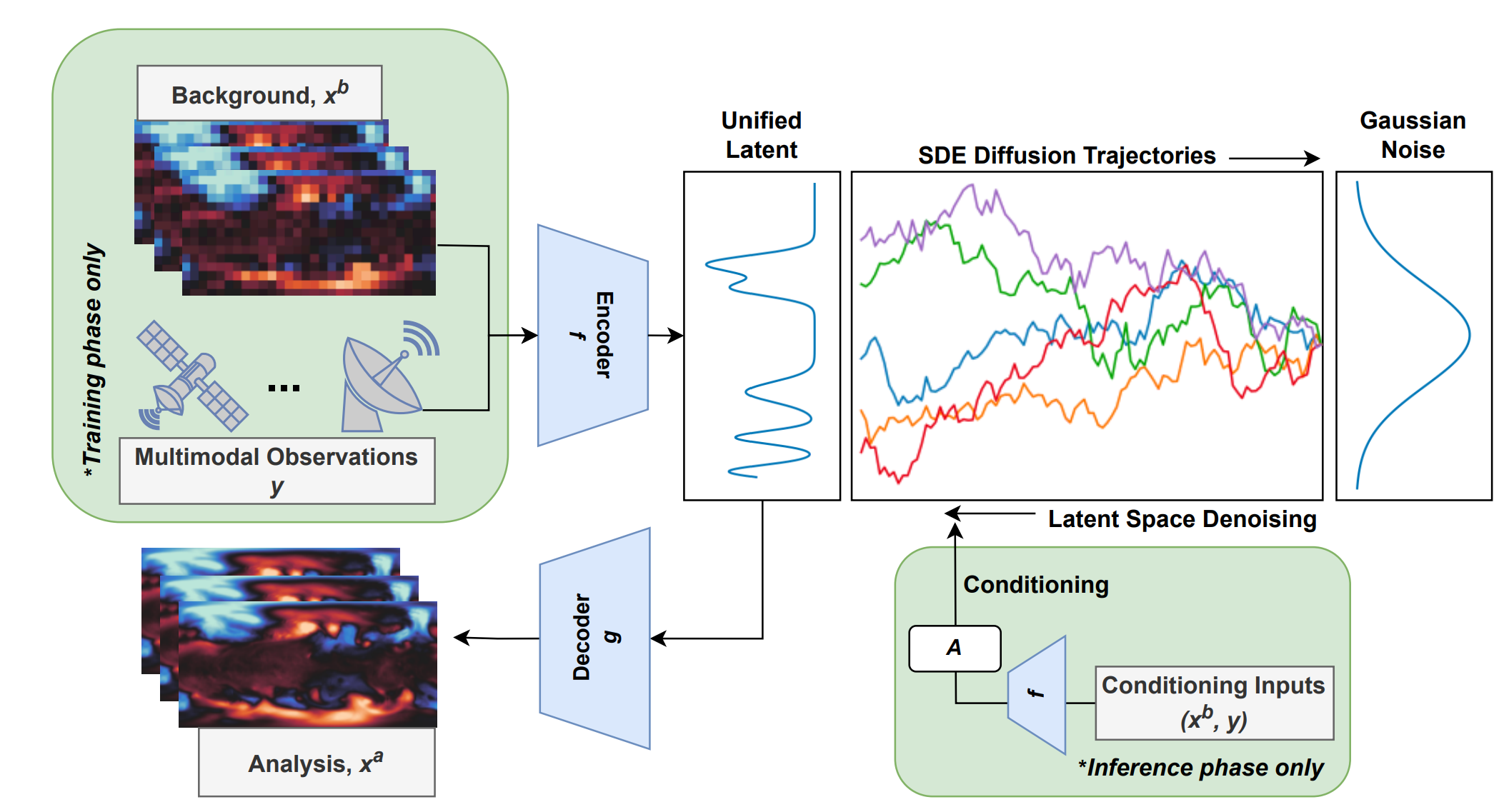
Our work introduces a distribution-aware assimilation framework built on Bayesian generative modeling to learn, update, and propagate the probability distributions of climate variables.
A framework for next-generation climate inference
Uncertainty-aware inference of climate parameters consistent with both physics and observational constraints.
Tail-resolving characterization of extremes beyond Gaussian or linear assumptions.
More stable climate projections under noisy, sparse, or biased observations.
What this framework enables
- Probabilistic long-range climate estimation
- Quantile-based risk and extreme-value analysis
- Physics-informed generative surrogates for ensembles
- Flexible coupling of ML models with dynamical systems
Representative Publications
- Li, S., Zheng, T., Farchi, A., Bocquet, M., & Gentine, P. (2025). Probabilistic data assimilation for ensemble distribution projections with generative machine learning: A Lorenz’96 proof-of-concept. Geophysical Research Letters. 🔗 Read the paper
- Qu, Y., Nathaniel, J., Li, S., & Gentine, P. (2024). Deep generative data assimilation in multimodal setting. CVPR 2024. 📄 PDF on CVF OpenAccess